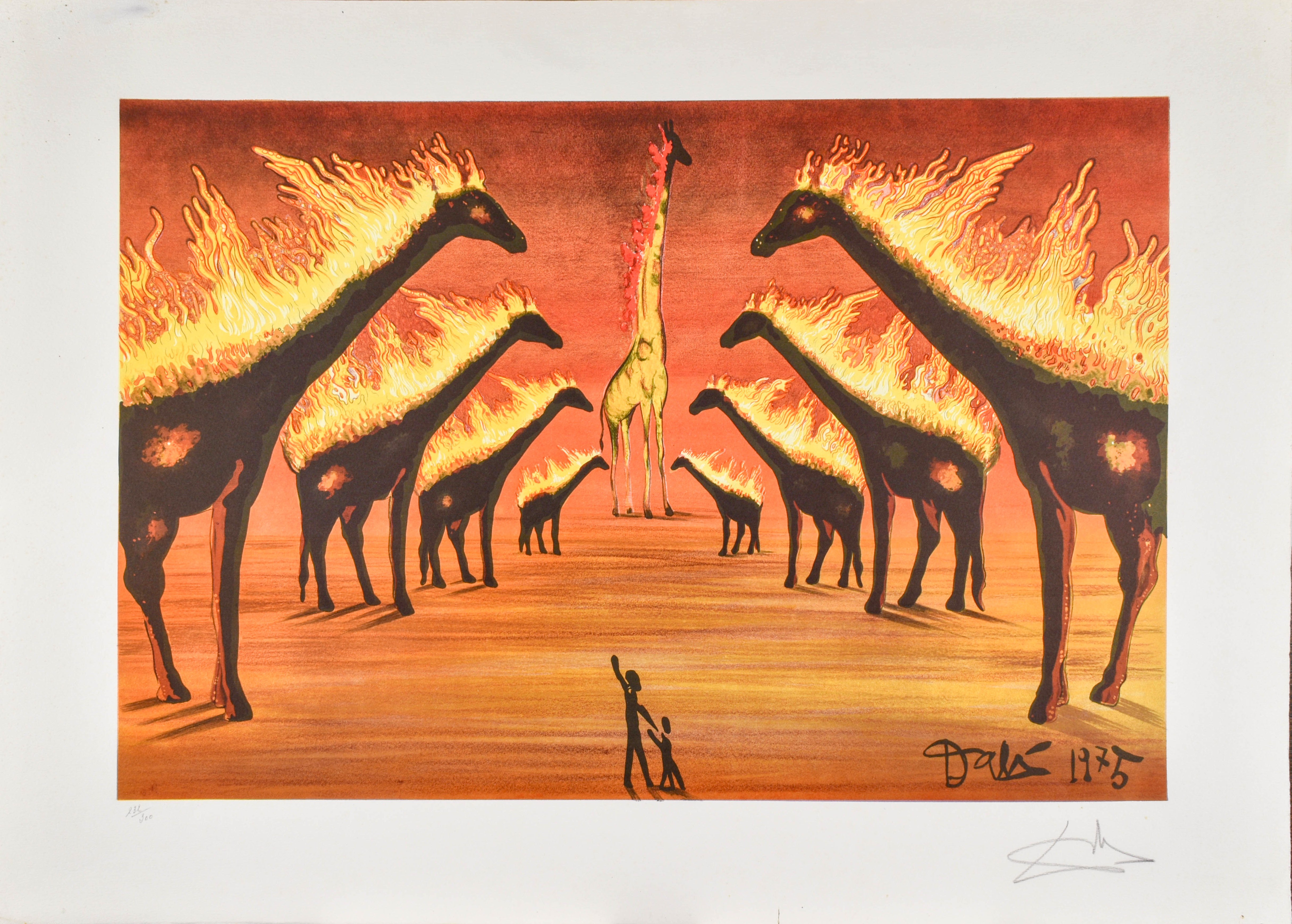
Last night I dreamed I was standing among a family of burning giraffes. I felt the heat piercing my skin, the stench of burning flesh in my nostrils, and the fumes frying my eyes so much that I had to squint just to see. I was completely convinced. It was only upon waking that I realized how wrong my sense of reality had been.
This is an essential problem: our reality is never observed indubitably, it is perceived.
Reality as we know it is not fully real. But it is real enough (for now).
Consider how few tools we are given. We have exactly five senses, and no more. A platypus, on the other hand, can detect the electric fields generated by muscle contractions in its prey, a sense called electroreception. Imagine what we might do with it. The following example may help illustrate this:
Suppose I visit a friend who asks whether I like his new haircut. I say yes, it looks great. With electroreception, he reads the deep contractions in my muscles and knows immediately that I am lying. His haircut is, in fact, ugly, and now he knows it. In this way, we have removed dishonesty from human interaction. Court testimony, negotiation, things that ought to be truthful, can no longer be done “asynchronously”. A written paper can lie in ways a living voice cannot. Perhaps then scientific peer review becomes a live event, some sort of academic sermon that has to be performed before publication.
However, we were not given the gift of electroreception, but our lack of senses may be what drove us to build something remarkable in its place.
We invented mathematics, not just as a counting tool, but as a language for reasoning about the invisible. We built instruments that extend our perception with it: microscopes, telescopes, sensors that detect what no eye could see unaided. We developed statistics to tell us how much to trust what we observe, and the scientific method to ask whether our hypotheses adhere to reality. These are like prosthetics for us limited creatures, but so far, they have worked extraordinarily well. No other species we know of has come close to this kind of understanding.
But yet, these tools only provide mere approximations (extraordinarily good ones, but still approximations). Our models of the universe fit the data we have gathered, but not the universe itself.
This brings us back to the giraffes. How confident can we be, standing in what we call the waking world, that we are not still dreaming? We are doing the best we can with what we have. But who is to say it is enough?