This paper is joint work with Ryan Murray. You can view the paper via the link above.
Prior work established this metastability for isotropic attention (Geshkovski et al., 2024); this paper analyzes anisotropic key matrices, computing the stability spectrum of the two-cluster state as a function of its orientation and measuring how its lifetime scales with the number of tokens.
Updated October 2026: this version states the model with softmax normalization to match the simulations and gives the corresponding eigenvalues.
A web version of the paper is given below.
Abstract
We study metastability in the transformer attention dynamics of (Geshkovski et al., 2025), where $n$ tokens evolve as interacting particles on $S^{d-1}$. Before the eventual collapse to a single consensus point, the dynamics often pass through a prolonged bipodal phase that dominates the total evolution time; metastability of multi-cluster states was established for the isotropic model in (Geshkovski et al., 2024). For $Q = V = I$, $\beta = 1$, softmax normalization and $K = \mathrm{diag}(a,b)$ on $S^1$, linearization around the two-cluster equilibrium yields a single positive Jacobian eigenvalue $2/(e^{2\gamma}+1)$, where $\gamma(\phi) = a\cos^2\phi + b\sin^2\phi$, making the bipodal state an unstable saddle with exponentially slow escape; in our simulations the clusters align with the dominant axis of $K$. Numerically, the convergence time satisfies $T(n) \approx C(a,b)\ln n + D(a,b)$, where $C$ grows exponentially in $\gamma^{\ast} = \max(a,b)$ and is smallest for isotropic $K$. The same three-phase behavior is also observed on $S^2$.
Introduction
The mathematical study of transformer architectures (Vaswani et al., 2023) has attracted growing interest, motivated in part by the observation that the discrete layer-by-layer processing of tokens can be recast as a continuous-time dynamical system. Following the perspective put forward for residual networks (E, 2017) (Chen et al., 2019), one views the successive layers as time discretizations of a continuous dynamical system of interacting particles. Layer normalization constrains each token to the unit sphere $S^{d-1}$, while the self-attention mechanism provides a nonlinear coupling between tokens. Together, these give rise to the following interacting particle system, studied in detail by (Geshkovski et al., 2025): $n$ particles $x_1(t),\ldots,x_n(t)$ on $S^{d-1} \subset \mathbb{R}^d$ evolve as
$$ \dot{x}_i(t) = P^{\perp}_{x_i(t)}\!\left( \frac{1}{Z_i(t)} \sum_{j=1}^{n} e^{\beta \langle Q x_i, K x_j\rangle} V x_j \right), \tag{1} $$
where $P^{\perp}_x y = y - \langle x, y\rangle x$ is the tangent-space projection and $Z_i$ is a normalization constant.
Under mild assumptions, all particles eventually collapse to a single consensus point (Geshkovski et al., 2025). Before collapsing, trajectories can remain near multi-cluster configurations for very long times: this dynamic metastability was proved in (Geshkovski et al., 2024) for well-separated initial data, and metastable clustering in the mean-field limit is studied in (Bruno et al., 2025). In this writeup we focus on the intermediate dynamics and on the simplest metastable state, two antipodal clusters. In many (though not all) of our simulations on $S^1$, the system forms two nearly antipodal clusters within a few hundred Euler steps, then remains in this bipodal configuration for orders of magnitude longer before the final collapse occurs; in those runs the system spends the vast majority of its total evolution in the two-cluster regime.
Our analytical results are specific to $d = 2$. We restrict to the simplified setting $Q = V = I$, $\beta = 1$, and $K = \mathrm{diag}(a,b)$ with $d = 2$, in which the dynamics reduce to a system of angular ODEs on $S^1$, and we show through linearization that the bipodal states are unstable equilibria. We also show an example on $S^2$ in Numerical Dynamics on $S^2$.
Setup and Reduction to Angular Dynamics
We work with $n$ points on $S^1 \subset \mathbb{R}^2$, parametrized by angles $\theta_i(t)$ so that $x_i(t) = (\cos\theta_i(t), \sin\theta_i(t))$. Setting $Q = V = I$, $\beta = 1$, and using softmax normalization, $Z_i = \sum_{j=1}^n e^{\langle x_i, K x_j\rangle}$, the dynamics (1) reduce to (see Appendix A for the derivation):
$$ \dot{\theta}_i(t) = -\frac{1}{Z_i(t)}\sum_{j=1}^{n} e^{w_{ij}(t)} \sin(\theta_i(t) - \theta_j(t)), \qquad Z_i = \sum_{j=1}^{n} e^{w_{ij}}, \tag{2} $$
where
$$ w_{ij} = \frac{a+b}{2}\cos(\theta_i - \theta_j) + \frac{a-b}{2}\cos(\theta_i + \theta_j). $$
Remark. When $K = 0$, we have $w_{ij} = 0$ and $Z_i = n$, and the dynamics (2) reduce to the classical Kuramoto model (Kuramoto, 1975) with zero natural frequencies and uniform coupling (see Appendix B for derivation).
The Three Phases of Evolution
When the bipodal phase occurs, the runs show a three-phase pattern. All simulations integrate (1) with forward Euler steps of size $h = 0.1$, and times are reported in Euler steps.
-
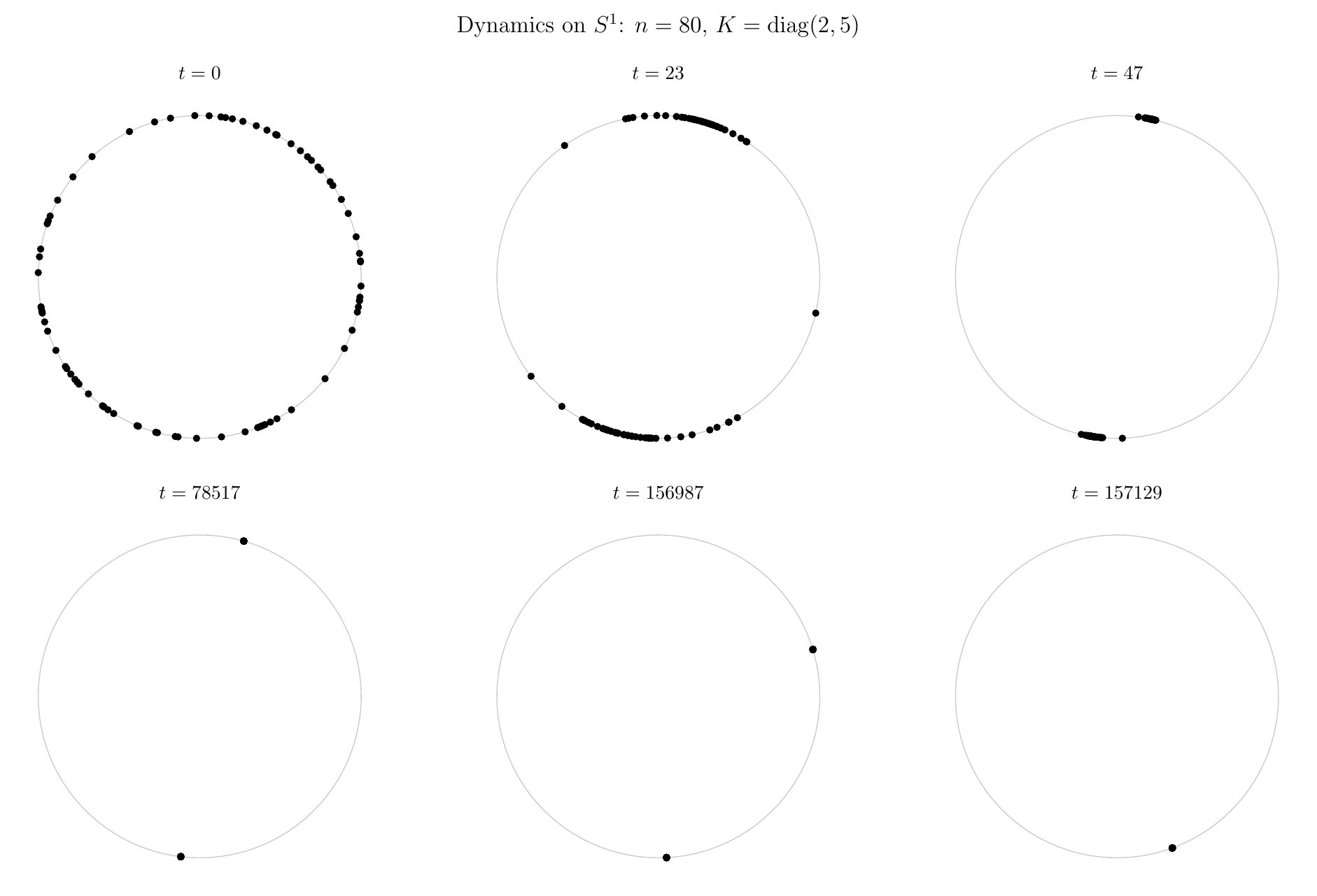
Phase I: Rapid clustering. Starting from random initial conditions, the particles quickly sort themselves into two clusters on roughly opposite sides of the circle.
-
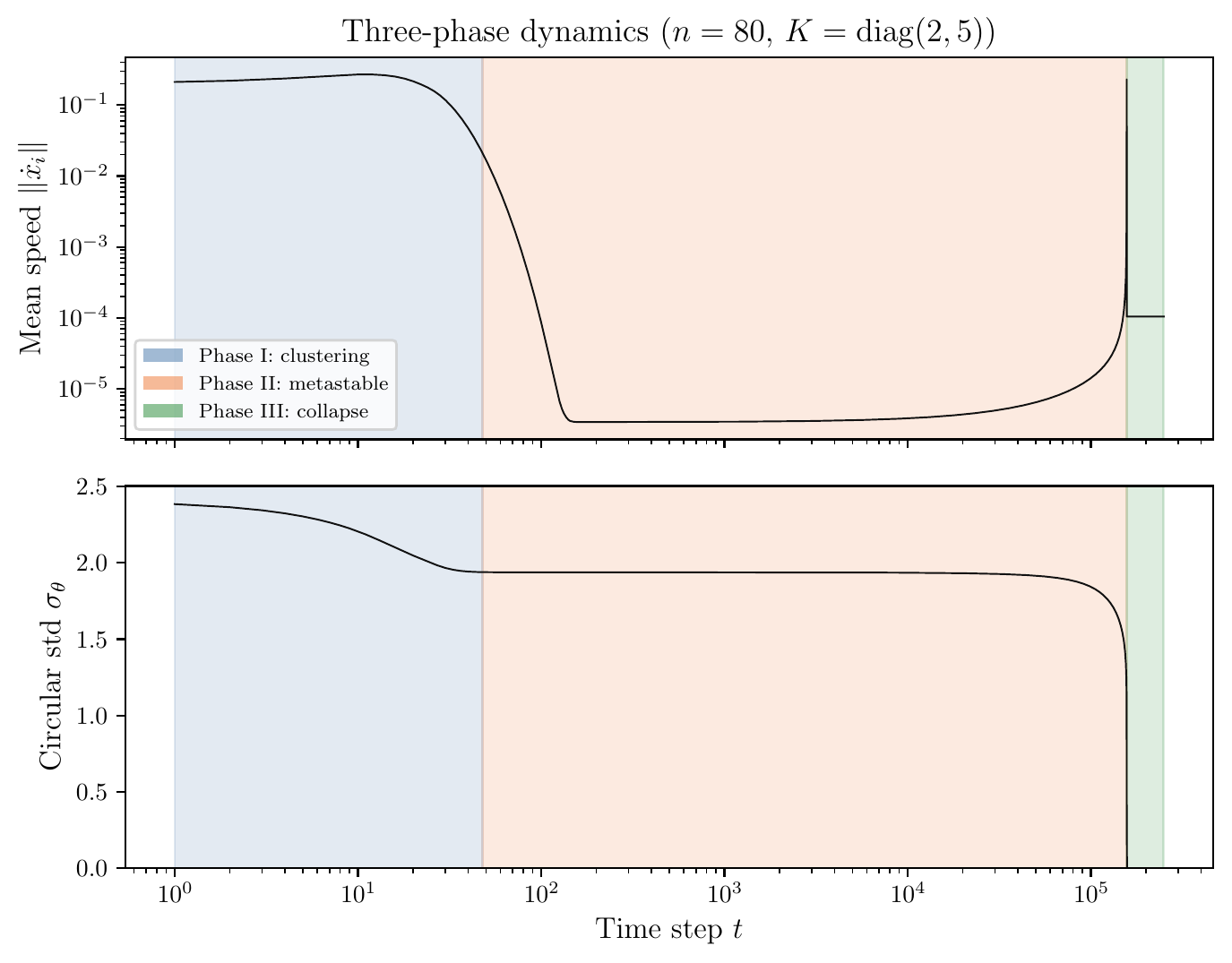
Phase II: Metastable plateau. The two clusters sit nearly antipodally and evolve extremely slowly. The speed $\|\dot{x}_i\|$ drops by several orders of magnitude. This phase dominates the total evolution time.
-
Phase III: Final collapse. One cluster eventually overtakes the other, and all particles rapidly merge into a single consensus point.
The figure below shows the geometry at representative snapshots. The initial random cloud quickly condenses into two tight clusters on opposite sides of the circle (Phase I), these clusters then sit nearly frozen for a long period (Phase II), before one absorbs the other in a rapid final merger (Phase III).
The following figure makes the time-scale separation quantitative, showing that the mean particle speed drops by several orders of magnitude at the Phase I–II transition and remains depressed throughout the plateau; in this run Phase I ends after 47 steps and Phase II occupies more than 99% of the evolution.
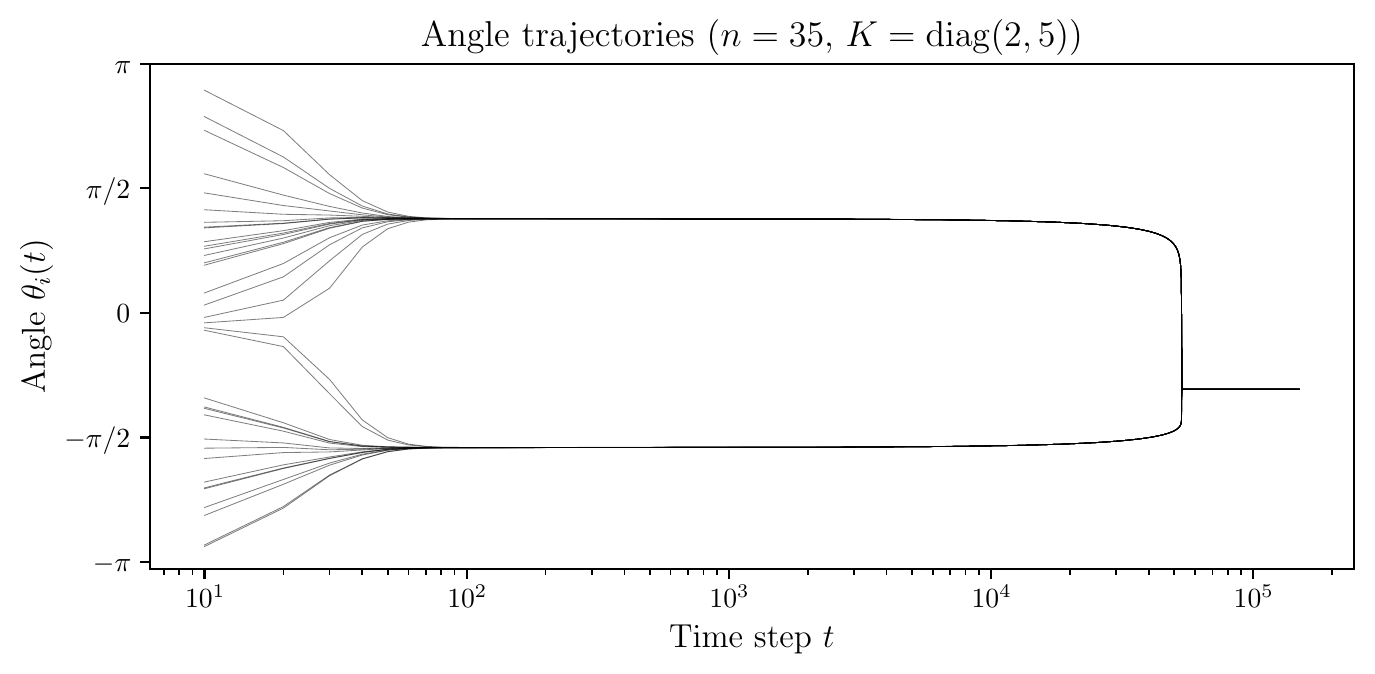
The next figure shows the two clusters settling near $\theta \approx \pm\pi/2$, aligned with the axis corresponding to the larger diagonal entry $b = 5$ of $K$. This is the orientation at which, by Linearized Analysis of the Bipodal State, escape from the bipodal state is slowest.
Linearized Analysis of the Bipodal State
To understand the metastable behavior analytically, we linearize the dynamics (2) about the two-cluster equilibrium.
Consider a perfectly bipodal configuration at angle $\phi$:
$$ \theta = (\underbrace{\phi, \ldots, \phi}_{n/2},\ \underbrace{\phi + \pi, \ldots, \phi + \pi}_{n/2}). $$
Define
$$ \gamma(\phi) := a\cos^2\phi + b\sin^2\phi, \tag{3} $$
which interpolates between $\gamma(0) = a$ and $\gamma(\pi/2) = b$. A direct computation of the Jacobian at this configuration yields the eigenvalues (see Appendix C for the full derivation):
$$ \lambda_1 = 0, \qquad \lambda_2 = \cdots = \lambda_{n-1} = -\tanh(\gamma), \qquad \lambda_n = \frac{e^{-\gamma}}{\cosh\gamma} = \frac{2}{e^{2\gamma} + 1} > 0. \tag{4} $$
For isotropic $K$, the same split into intra-cluster and inter-cluster modes appears in classical stability analyses of symmetric cluster states of coupled phase oscillators (Okuda, 1993). The eigenvalue structure (4) has a direct dynamical interpretation. The zero eigenvalue $\lambda_1 = 0$ (eigenvector $(1, \ldots, 1)$) reflects that the bipodal state sits in a one-parameter family of equilibria parametrized by $\phi$. The $n-2$ negative eigenvalues $-\tanh(\gamma)$ enforce within-cluster cohesion once approximate clusters form, completing Phase I. The single positive eigenvalue $\lambda_n = 2/(e^{2\gamma}+1) \approx 2e^{-2\gamma}$ controls the escape rate from the bipodal saddle: since $\gamma(\phi) = a\cos^2\phi + b\sin^2\phi \in [\min(a,b),\,\max(a,b)]$, the value of $\gamma$ is determined by $a$, $b$ and the orientation $\phi$. When $a$ and $b$ are large, $\lambda_n$ is exponentially small, making escape from the saddle extremely slow and the metastable lifetime exponentially long.
Since the unstable eigenvalue decreases as $\gamma(\phi)$ grows, the most metastable bipodal state (slowest escape) occurs at the orientation $\phi^{\ast}$ that maximizes $\gamma(\phi) = a\cos^2\phi + b\sin^2\phi$. If $a > b$, then $\phi^{\ast} = 0$ (clusters along the $e_1$-axis); if $b > a$, then $\phi^{\ast} = \pi/2$ (clusters along the $e_2$-axis). The linearization identifies this as the slowest-escaping orientation; it does not by itself show that trajectories reach it. In the runs shown above, with $K = \mathrm{diag}(2,5)$ and $b > a$, the two clusters settle near $\theta \approx \pm\pi/2$, the $e_2$-axis, and in the $S^2$ run of Numerical Dynamics on $S^2$ they settle along the dominant $z$-axis.
Additionally, we note one proposition about the dynamics:
Proposition 1: Unique semicircular equilibrium
If $\theta^{\ast}$ is an equilibrium with all angles contained in an open semicircle (i.e., $\max_i \theta_i^{\ast} - \min_i \theta_i^{\ast} < \pi$), then $\theta_1^{\ast} = \cdots = \theta_n^{\ast}$.
Proof
Let $m = \arg\max_k \theta_k^{\ast}$. At equilibrium, $0 = \dot\theta_m^{\ast}$, which (since $Z_m > 0$) means $0 = \sum_{j=1}^{n} e^{w_{mj}}\sin(\theta_m^{\ast} - \theta_j^{\ast})$. Since $\max_i\theta_i^{\ast} - \min_i\theta_i^{\ast} < \pi$, each term satisfies $\sin(\theta_m^{\ast} - \theta_j^{\ast}) \geq 0$ with $e^{w_{mj}} > 0$. A sum of non-negative terms can only be zero if every term is zero, i.e., $\sin(\theta_m^{\ast} - \theta_j^{\ast}) = 0$ for all $j$. Since $\lvert\theta_m^{\ast} - \theta_j^{\ast}\rvert < \pi$, this forces $\theta_j^{\ast} = \theta_m^{\ast}$ for all $j$.
∎
This rules out non-consensus equilibria confined to a semicircle. The proposition is the circle case of a more general result: for $V = I$, particles starting in an open hemisphere converge to a single point (Lemma 6.4 of (Geshkovski et al., 2025)).
Scaling Laws
The eigenvalue analysis of Linearized Analysis of the Bipodal State suggests that the duration of the metastable plateau grows exponentially in $\gamma$. To quantify the dependence on $n$ we record $T$, the number of Euler steps until $\sigma_\theta < 0.05$ (Euler step $h = 0.1$), sweeping 30 to 47 log-spaced values of $n$ per configuration. For the isotropic case $K = aI$ we test $a \in \{1.0, 1.5, 2.0, 2.5, 3.0, 3.5, 4.0, 4.5, 5.0\}$. For anisotropic $K = \mathrm{diag}(a,b)$ with $a \neq b$, we test seven $\gamma^{\ast}$-levels spanning $\{2.0, 2.5, 3.0, 3.5, 4.0, 4.5, 5.0\}$, using two distinct $(a,b)$ pairs per level. To account for the exponential growth of run-time, $n$ ranges from $5$ to $3000$ with 20 seeds per point for $\gamma^{\ast} \leq 3$, and from $5$ to $500$ with 10 seeds per point for $\gamma^{\ast} \geq 3.5$.
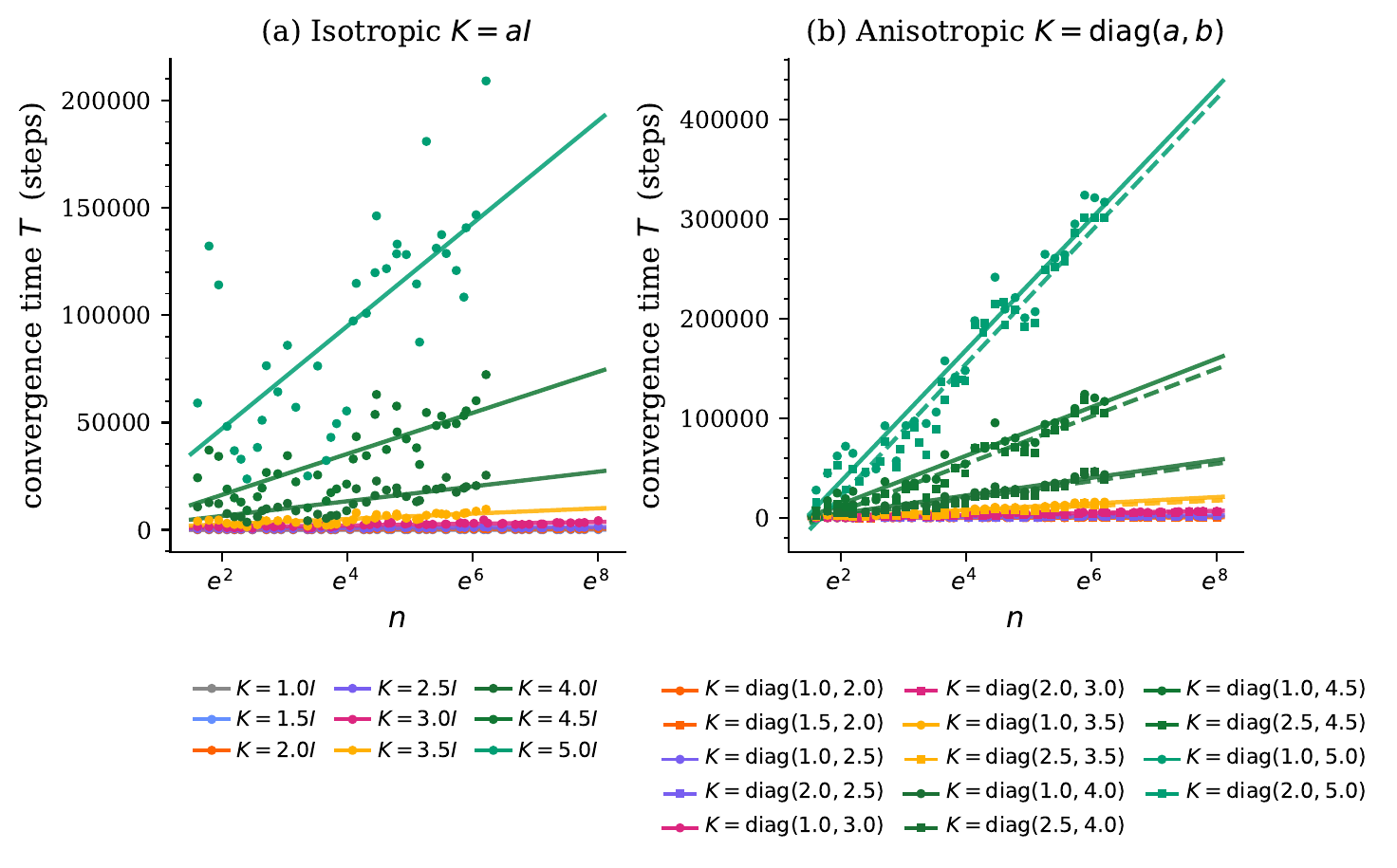
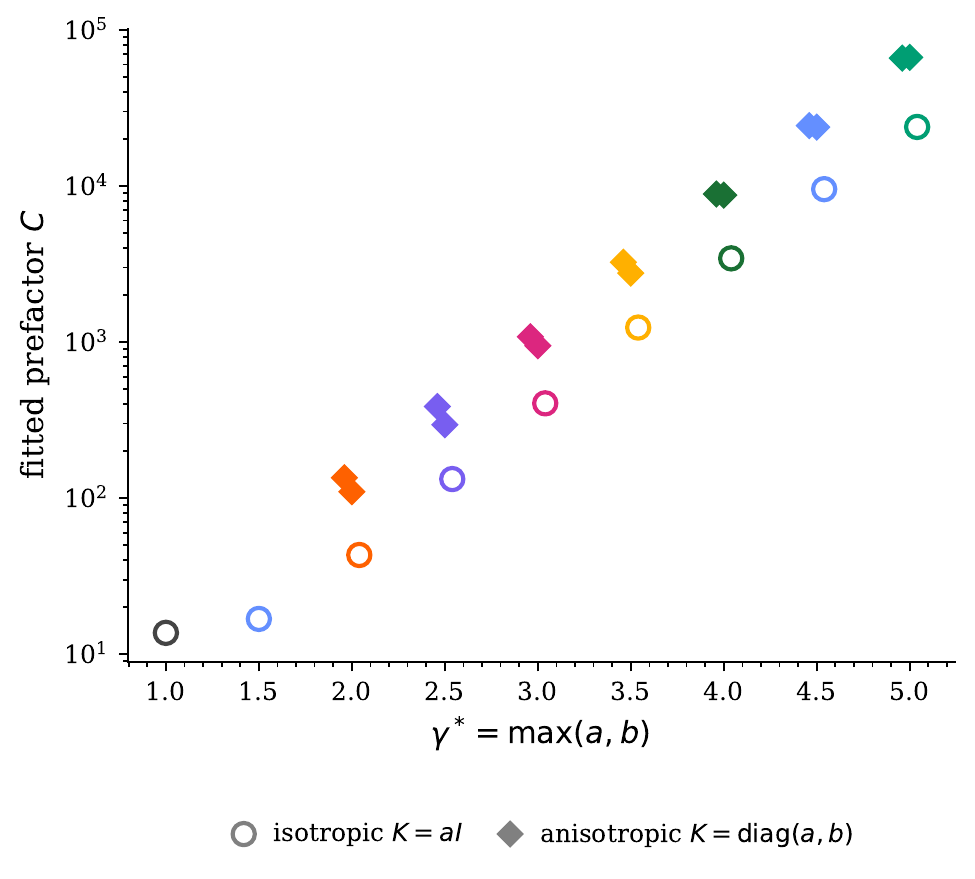
The figures below show that both isotropic and anisotropic $K$ are fit by the same logarithmic scaling law; the anisotropic fits are tighter ($R^2 = 0.88$ to $0.97$, against $0.50$ to $0.93$ for isotropic $K$), and anisotropic pairs have substantially larger prefactors $C$ than the isotropic case at the same $\gamma^{\ast}$.
For an anisotropic $K = \mathrm{diag}(a,b)$, $a \neq b$, the convergence time follows a logarithmic law,
$$ T(n) \;\approx\; C(K)\,\ln n + D(K), \tag{5} $$
with fitted slope $C(K)$ that grows exponentially in $\gamma^{\ast} = \max(a,b)$. However, $C$ is not determined by $\gamma^{\ast}$ alone: for $\gamma^{\ast} \leq 3.5$, the pair with smaller anisotropy $b - a$ has the smaller fitted slope at each level, while for $\gamma^{\ast} \geq 4$ the two pairs at each level agree within the fitting error.
The isotropic case, with $K = aI$, is also fit by $T(n) \approx C(a,a)\,\ln n + D(a,a)$, with a substantially smaller prefactor than both anisotropic pairs sharing the same $\gamma^{\ast} = a$. For $a \in \{1.5, 2\}$ this makes the isotropic curves nearly flat over the range $n \in [100, 3000]$ (fitted slopes there are not distinguishable from zero); for large $a$ (e.g. $a \geq 3.5$) the logarithmic growth is visible even in isotropic data. The isotropic entry forms the lower boundary at each $\gamma^{\ast}$ level.
| $K$ | $b - a$ | $\gamma^{\ast}$ | $C(K)$ (fitted) |
|---|---|---|---|
| $\mathrm{diag}(1.5,1.5)$ | $0$ | $1.5$ | $16.8$ |
| $\mathrm{diag}(2,2)$ | $0$ | $2.0$ | $43.2$ |
| $\mathrm{diag}(1,2)$ | $1.0$ | $2.0$ | $135$ |
| $\mathrm{diag}(2.5,2.5)$ | $0$ | $2.5$ | $132$ |
| $\mathrm{diag}(3,3)$ | $0$ | $3.0$ | $405$ |
| $\mathrm{diag}(1,3)$ | $2.0$ | $3.0$ | $1{,}080$ |
| $\mathrm{diag}(5,5)$ | $0$ | $5.0$ | $23{,}885$ |
| $\mathrm{diag}(2,5)$ | $3.0$ | $5.0$ | $66{,}615$ |
The figure below plots the fitted slope $C$ against $\gamma^{\ast}$ for every simulated $K$. The anisotropic entries (diamonds) grow exponentially in $\gamma^{\ast}$; at fixed $\gamma^{\ast} \leq 3.5$ the pair with smaller anisotropy $b - a$ has the smaller $C$. The isotropic entries (circles) form the lower boundary at each $\gamma^{\ast}$.
Numerical Dynamics on $S^2$
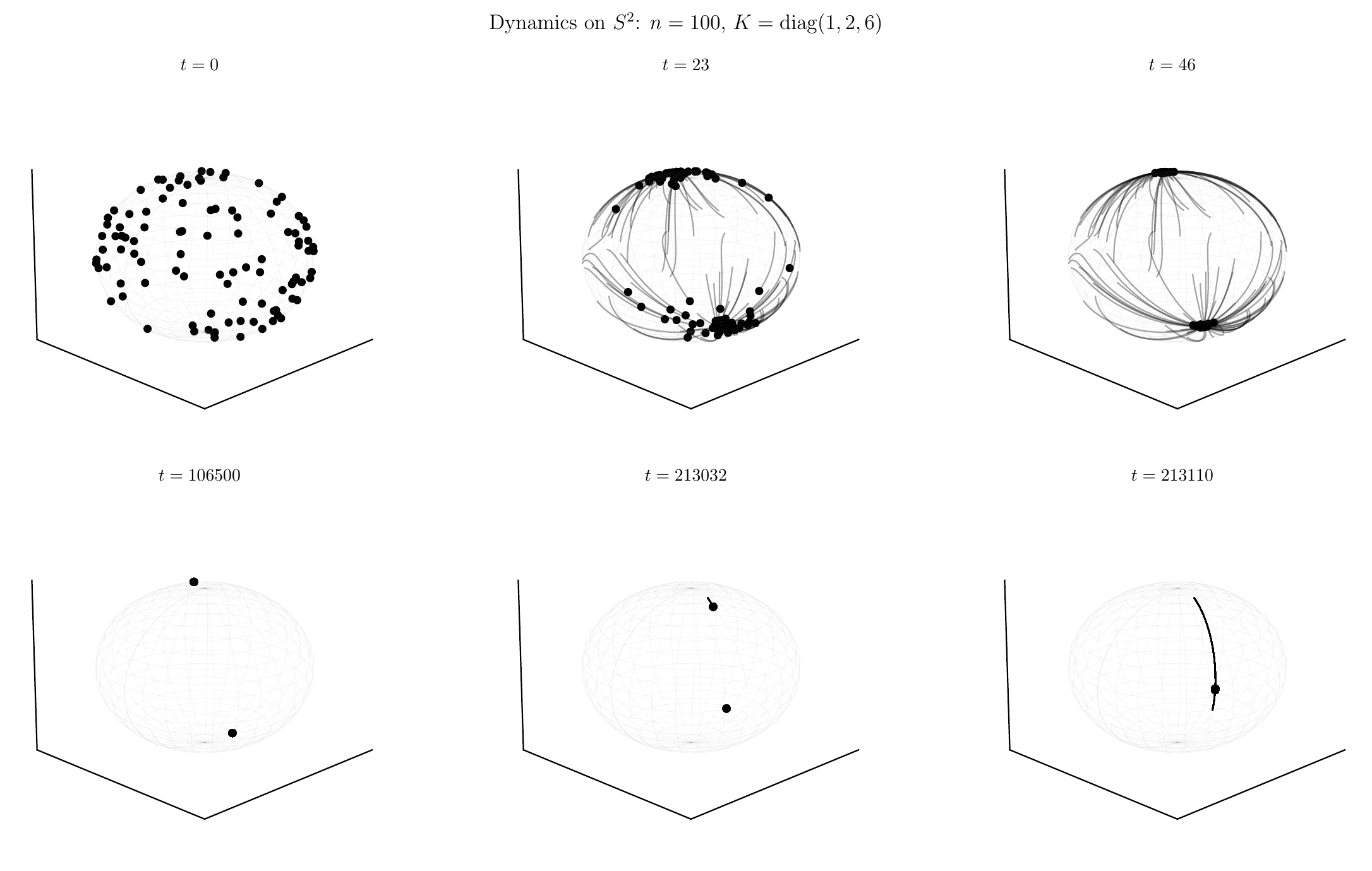
The metastable phenomenon is not limited to the circle; we show here an example in $d = 3$, though an analytical treatment analogous to Linearized Analysis of the Bipodal State remains open. The figure below shows the dynamics of $n = 100$ particles on $S^2 \subset \mathbb{R}^3$ with $K = \mathrm{diag}(1, 2, 6)$. The same three-phase pattern is visible, with a rapid initial sorting into two antipodal clusters (Phase I), a prolonged plateau during which the clusters are nearly stationary (Phase II), and a final collapse to a single consensus point (Phase III).
The dominant axis of $K$ is the $z$-axis (eigenvalue $6$), and in this run the metastable clusters settle near the north and south poles.
Discussion & Open Problems
The linearization reveals that the bipodal state has one small unstable direction, and the system takes a long time to find it. Simulations show that the escape time is fit by $T(n) \approx C(K)\ln n + D(K)$ for all tested $K$, with the prefactor $C$ growing exponentially in $\gamma^{\ast}$ and smallest for isotropic $K$. We close with two open problems.
Conjecture 1: Logarithmic scaling law
For $K = \mathrm{diag}(a,b)$ with $a \neq b$ and random initial conditions, the escape time satisfies
$$ T(n) \;=\; C(a,b)\,\ln n + D(a,b) \qquad \text{as } n \to \infty, $$
where $C(a,b)$ grows exponentially in $\gamma^{\ast} = \max(a,b)$. The isotropic case $b = a$ follows the same law with $C(a,a)$ the smallest value at fixed $\gamma^{\ast} = a$.
The logarithmic law fits all simulated pairs. A rigorous proof remains open.
Conjecture 2: Lyapunov structure
For $K = \mathrm{diag}(a,b)$ with $a \neq b$, there is an energy function $E\colon (S^1)^n \to \mathbb{R}$ for the dynamics (2) such that bipodal states are saddle points of $E$ and consensus states are local minima.
For $K = 0$ (the Kuramoto model) and, more generally, isotropic $K = aI$, the dynamics are known to be a gradient flow of an interaction energy, with respect to a suitably modified metric (Geshkovski et al., 2025); finding an energy function for $a \neq b$ remains open.
Appendix A: Derivation of the Angular ODE
We show the reduction from (1) to (2) under the assumptions $Q = V = I$, $\beta = 1$, $K = \mathrm{diag}(a,b)$, and softmax normalization $Z_i = \sum_j e^{\langle x_i, K x_j\rangle}$. Each particle lives on $S^1$, so we write
$$ x_i(t) = \cos(\theta_i(t))\, e_1 + \sin(\theta_i(t))\, e_2. $$
We first compute $\langle x_i, Kx_j \rangle$. Since $K = \mathrm{diag}(a,b)$, we have
$$ \langle x_i, Kx_j \rangle = a\cos\theta_i\cos\theta_j + b\sin\theta_i\sin\theta_j = \frac{a+b}{2}\cos(\theta_i - \theta_j) + \frac{a-b}{2}\cos(\theta_i + \theta_j), $$
where the second equality follows from the product-to-sum identities. We denote this quantity $w_{ij}$, so that $\langle x_i, Kx_j \rangle = w_{ij}$. To extract an ODE for $\theta_i$, we differentiate the identity $\cos(\theta_i(t)) = \langle x_i(t), e_1 \rangle$ with respect to $t$, giving
$$ -\sin(\theta_i)\,\dot{\theta}_i = \langle \dot{x}_i, e_1 \rangle. $$
Substituting the dynamics $\dot{x}_i = P^{\perp}_{x_i}\!\bigl(\frac{1}{Z_i}\sum_j e^{w_{ij}} x_j\bigr)$ and using $\langle P^{\perp}_{x_i} v, e_1 \rangle = \langle v, e_1 \rangle - \langle v, x_i \rangle\cos\theta_i$ yields
$$ -\sin(\theta_i)\,\dot{\theta}_i = \frac{1}{Z_i}\sum_{j=1}^{n} e^{w_{ij}}\Bigl[\langle x_j, e_1\rangle - \langle x_j, x_i\rangle\cos\theta_i\Bigr]. $$
Substituting $\langle x_j, e_1 \rangle = \cos\theta_j$ and $\langle x_j, x_i \rangle = \cos(\theta_i - \theta_j)$ and dividing by $-\sin(\theta_i)$, the bracket becomes
$$ \frac{\cos\theta_j - \cos(\theta_i - \theta_j)\cos\theta_i}{\sin\theta_i} = \sin(\theta_i - \theta_j), $$
where the last step is a standard trigonometric identity (expanding $\cos(\theta_i - \theta_j) = \cos\theta_i\cos\theta_j + \sin\theta_i\sin\theta_j$ and simplifying). This gives (2).
Appendix B: Derivation of the Kuramoto Model
We show that when $K = 0$ the dynamics (2) reduce to the Kuramoto model with zero natural frequencies. Setting $K = 0$ means $w_{ij} = 0$ for all $i,j$, hence $Z_i = n$, so (2) becomes
$$ \dot{\theta}_i(t) = -\frac{1}{n}\sum_{j=1}^{n}\sin(\theta_i(t) - \theta_j(t)) = \frac{1}{n}\sum_{j=1}^{n}\sin(\theta_j(t) - \theta_i(t)), $$
which is exactly the Kuramoto model
$$ \dot{\theta}_i(t) = \omega_i + \frac{\kappa}{n}\sum_{j=1}^{n}\sin(\theta_j(t) - \theta_i(t)) $$
with natural frequencies $\omega_i = 0$ and coupling strength $\kappa = 1$.
Appendix C: Derivation of the Eigenvalues
We derive the eigenvalues (4) of the Jacobian of the right-hand side $g$ of (2) at a bipodal state. It is convenient to write $g_i = (n/Z_i)\, f_i$, where $f_i(\theta) = -\frac{1}{n}\sum_j e^{w_{ij}}\sin(\theta_i - \theta_j)$ is the corresponding uniformly normalized field. We first compute the Jacobian $A = D_\theta f$, evaluated at the general bipodal state
$$ \theta^{\ast} = (\underbrace{\phi, \ldots, \phi}_{n/2},\; \underbrace{\phi+\pi, \ldots, \phi+\pi}_{n/2}). $$
To compute the Jacobian, we introduce the shorthand $s_{ij} = \sin(\theta_i - \theta_j)$ and $c_{ij} = \cos(\theta_i - \theta_j)$. Differentiating $f_i$ with respect to $\theta_k$ requires the partial derivatives of both $s_{ij}$ and $w_{ij}$. For $s_{ij}$, we have
$$ \frac{\partial s_{ij}}{\partial \theta_k} = c_{ij}(\delta_{ik} - \delta_{jk}). $$
For $w_{ij} = \frac{a+b}{2}\cos(\theta_i - \theta_j) + \frac{a-b}{2}\cos(\theta_i + \theta_j)$, differentiating gives
$$ \frac{\partial w_{ij}}{\partial \theta_i} = -\frac{a+b}{2}s_{ij} - \frac{a-b}{2}\sin(\theta_i + \theta_j), \qquad \frac{\partial w_{ij}}{\partial \theta_j} = \frac{a+b}{2}s_{ij} - \frac{a-b}{2}\sin(\theta_i + \theta_j), $$
and $\frac{\partial w_{ij}}{\partial \theta_k} = 0$ for $k \notin \{i,j\}$. Substituting into the product-rule expansion of $\frac{\partial f_i}{\partial \theta_k}$ and separating the diagonal ($k = i$) and off-diagonal ($k \neq i$) cases yields
$$ \begin{aligned} A_{ii} &= -\frac{1}{n}\sum_{j \neq i} e^{w_{ij}} \Bigl[\frac{\partial w_{ij}}{\partial \theta_i} s_{ij} + c_{ij}\Bigr], \\[6pt] A_{ik} &= -\frac{1}{n}\, e^{w_{ik}} \Bigl[\frac{\partial w_{ik}}{\partial \theta_k} s_{ik} - c_{ik}\Bigr] \quad (k \neq i). \end{aligned} $$
Now we evaluate at $\theta^{\ast}$. The key observation is that $\theta_i - \theta_j$ is always either $0$ (within the same cluster) or $\pm\pi$ (across clusters), so $s_{ij} = \sin(\theta_i - \theta_j) = 0$ for every pair. Since every term involving $s_{ij}$ vanishes, the Jacobian entries simplify dramatically to
$$ A_{ii} = -\frac{1}{n}\sum_{j \neq i} e^{w_{ij}} c_{ij}, \qquad A_{ik} = \frac{1}{n} e^{w_{ik}} c_{ik} \quad (k \neq i). $$
It remains to evaluate $w_{ij}$ and $c_{ij}$. Recalling $\gamma = \gamma(\phi) = a\cos^2\phi + b\sin^2\phi$, a direct substitution gives:
- Within the same cluster ($\theta_i - \theta_j = 0$, $\theta_i + \theta_j = 2\phi$): $c_{ij} = 1$ and $w_{ij} = \gamma$.
- Across clusters ($\theta_i - \theta_j = \pm\pi$, $\theta_i + \theta_j = 2\phi \pm \pi$): $c_{ij} = -1$ and $w_{ij} = -\gamma$.
Setting $\mu = \frac{1}{n}e^{\gamma}$ and $\nu = \frac{1}{n}e^{-\gamma}$, each within-cluster off-diagonal entry equals $\mu$ and each cross-cluster off-diagonal entry equals $-\nu$. The diagonal entry for particle $i$ sums over $\frac{n}{2}-1$ within-cluster neighbors and $\frac{n}{2}$ cross-cluster neighbors:
$$ A_{ii} = -\!\left(\tfrac{n}{2}-1\right)\mu + \tfrac{n}{2}\nu. $$
Label the clusters $X$ (indices $1,\ldots,n/2$) and $Y$ (indices $n/2+1,\ldots,n$). The full Jacobian has the block form
$$ A = \begin{bmatrix} A_{XX} & A_{XY} \\ A_{YX} & A_{YY} \end{bmatrix}, $$
where $A_{XX} = A_{YY}$ has diagonal $-(\frac{n}{2}-1)\mu + \frac{n}{2}\nu$ and off-diagonal $\mu$, while $A_{XY} = A_{YX}$ is the $\frac{n}{2}\times\frac{n}{2}$ constant matrix with every entry equal to $-\nu$. This can be written as
$$ A = \underbrace{\left(-\tfrac{n}{2}\mu + \tfrac{n}{2}\nu\right)}_{= -\sinh\gamma} I + C, $$
where $C$ has blocks $\mu\,\mathbf{1}\mathbf{1}^\top$ on the diagonal and $-\nu\,\mathbf{1}\mathbf{1}^\top$ off the diagonal, with $\mathbf{1}$ denoting the all-ones vector of length $n/2$. Since the scalar shift $-\sinh(\gamma)$ moves all eigenvalues uniformly, we only need to find the eigenvalues of $C$.
$C$ is a rank-2 matrix. To see this, note that its column space is spanned by just two vectors: $v_+ = (\mathbf{1}, \mathbf{1}) \in \mathbb{R}^n$ and $v_- = (\mathbf{1}, -\mathbf{1}) \in \mathbb{R}^n$. A direct computation gives
$$ Cv_+ = \tfrac{n}{2}(\mu - \nu)\,v_+, \qquad Cv_- = \tfrac{n}{2}(\mu + \nu)\,v_-. $$
So $v_+$ and $v_-$ are eigenvectors of $C$ with eigenvalues
$$ \frac{n}{2}(\mu - \nu) = \frac{e^\gamma - e^{-\gamma}}{2} = \sinh(\gamma), \qquad \frac{n}{2}(\mu + \nu) = \frac{e^\gamma + e^{-\gamma}}{2} = \cosh(\gamma), $$
respectively, and all other $n-2$ eigenvalues of $C$ are $0$.
Adding back the scalar shift $-\sinh(\gamma)$ from the identity term, the eigenvalues of $A$ are:
$$ \begin{aligned} &-\sinh(\gamma) + \sinh(\gamma) = 0 &&\text{(multiplicity 1, eigenvector } v_+\text{),} \\ &-\sinh(\gamma) + 0 = -\sinh(\gamma) &&\text{(multiplicity } n-2\text{),} \\ &-\sinh(\gamma) + \cosh(\gamma) = e^{-\gamma} > 0 &&\text{(multiplicity 1, eigenvector } v_-\text{),} \end{aligned} $$
Finally, we pass to the softmax field $g_i = (n/Z_i) f_i$. By the product rule,
$$ \frac{\partial g_i}{\partial \theta_k} = \frac{n}{Z_i}\,\frac{\partial f_i}{\partial \theta_k} + f_i\,\frac{\partial}{\partial \theta_k}\Bigl(\frac{n}{Z_i}\Bigr), $$
and the second term vanishes at an equilibrium, where $f_i = 0$. At $\theta^{\ast}$, each particle has $\frac{n}{2}$ partners (itself included) with $w_{ij} = \gamma$ and $\frac{n}{2}$ with $w_{ij} = -\gamma$, so
$$ Z_i = \tfrac{n}{2}\,e^{\gamma} + \tfrac{n}{2}\,e^{-\gamma} = n\cosh(\gamma) \quad \text{for every } i. $$
Hence $D_\theta g = A/\cosh(\gamma)$, and the eigenvalues of $D_\theta g$ are those of $A$ divided by $\cosh(\gamma)$: $0$, $-\tanh(\gamma)$ (multiplicity $n-2$) and $e^{-\gamma}/\cosh(\gamma) = 2/(e^{2\gamma}+1)$, which is precisely (4). $\blacksquare$
References
- Geshkovski, B., Koubbi, H., Polyanskiy, Y., & Rigollet, P. (2024). Dynamic metastability in the self-attention model. https://arxiv.org/abs/2410.06833
- Geshkovski, B., Letrouit, C., Polyanskiy, Y., & Rigollet, P. (2025). A mathematical perspective on Transformers. https://arxiv.org/abs/2312.10794
- Vaswani, A., Shazeer, N., Parmar, N., Uszkoreit, J., Jones, L., Gomez, A. N., Kaiser, L., & Polosukhin, I. (2023). Attention Is All You Need. https://arxiv.org/abs/1706.03762
- E, W. (2017). A Proposal on Machine Learning via Dynamical Systems. Communications in Mathematics and Statistics, 5(1), 1–11. https://doi.org/10.1007/s40304-017-0103-z
- Chen, R. T. Q., Rubanova, Y., Bettencourt, J., & Duvenaud, D. (2019). Neural Ordinary Differential Equations. https://arxiv.org/abs/1806.07366
- Bruno, G., Pasqualotto, F., & Agazzi, A. (2025). Emergence of meta-stable clustering in mean-field transformer models. https://arxiv.org/abs/2410.23228
- Kuramoto, Y. (1975). Self-entrainment of a population of coupled non-linear oscillators. Lect. Notes Phys., 39, 420–422. https://doi.org/10.1007/BFb0013365
- Okuda, K. (1993). Variety and generality of clustering in globally coupled oscillators. Physica D: Nonlinear Phenomena, 63(3-4), 424–436. https://doi.org/10.1016/0167-2789(93)90121-G